Project overview
Introduction
Gesundheit Bewegt approached us with a challenge:
how can generative AI be connected to a large, diverse knowledge base that has been developed and expanded on WordPress over many years?
The main problem was that the AI tools used by the team had no direct access to the platform, which made their use limited, slow, and prone to manual errors.
Our task was to find a controlled and secure way to make the platform’s content and core operations available to large language models – without changing the existing architecture or workflow.
Client
Gesundheit Bewegt is a German company specializing in digital workplace health promotion programs. Its core product is an extensive online platform that combines training videos, courses, challenges, recipes, educational materials, and activity-tracking tools.
The platform is built around professionally created content developed by domain experts, helping employers take a structured approach to supporting the physical and mental health of their teams.
Problem – how to use AI with a large content base?
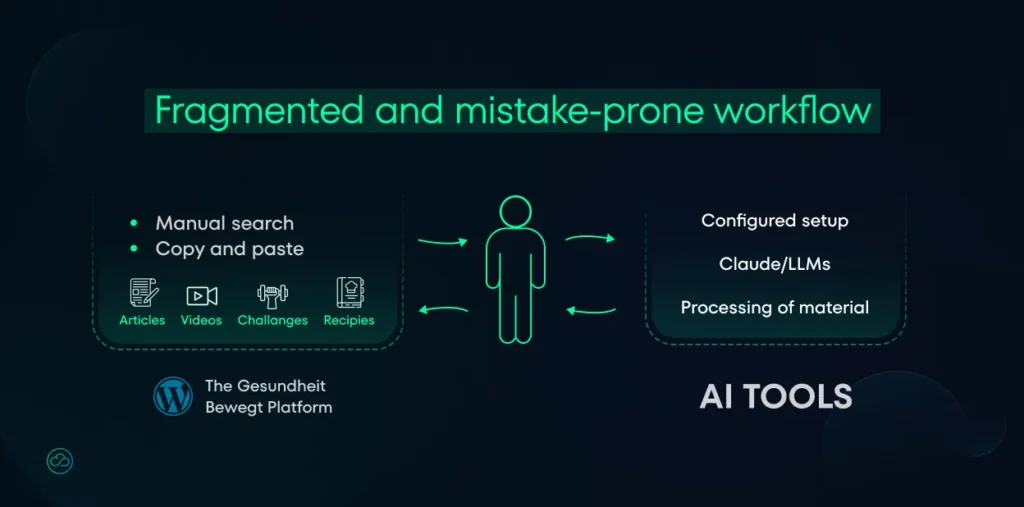
The Gesundheit Bewegt team was already using large language model tools, including Claude, to support editorial and conceptual work. The issue was that AI operated outside the WordPress ecosystem and had no direct access to the content stored on the platform.
As a result, the workflow was fragmented and inefficient. When creating new campaigns, thematic programs, or educational materials, editors had to manually search for content in the CMS, copy it into AI tools, and only then work with it. This process was slow, made it harder to work with full context, and increased the risk of overlooking valuable existing materials.
From a business perspective, the key requirement was to enable AI to operate directly within WordPress-based editorial workflows.
Challenge – technical constraints and solution security
Delivering such a solution involved several important technical challenges.
- This platform had been developed over years and relied on many custom content types, plugins, and extensions that went far beyond WordPress’s default CMS mechanisms. There was no off-the-shelf market solution that could securely connect AI tools directly to such a customized environment.
- At the same time, security and access control were critical. AI could not be given unrestricted access to the entire content database – user roles, permissions, and internal platform structure had to be respected.
- An additional constraint was the team’s existing way of working. Their AI tools were already configured and used daily, so the solution could not force them to switch models, tools, or usage patterns.
Solution – a dedicated MCP server for the WordPress environment
Why not RAG?
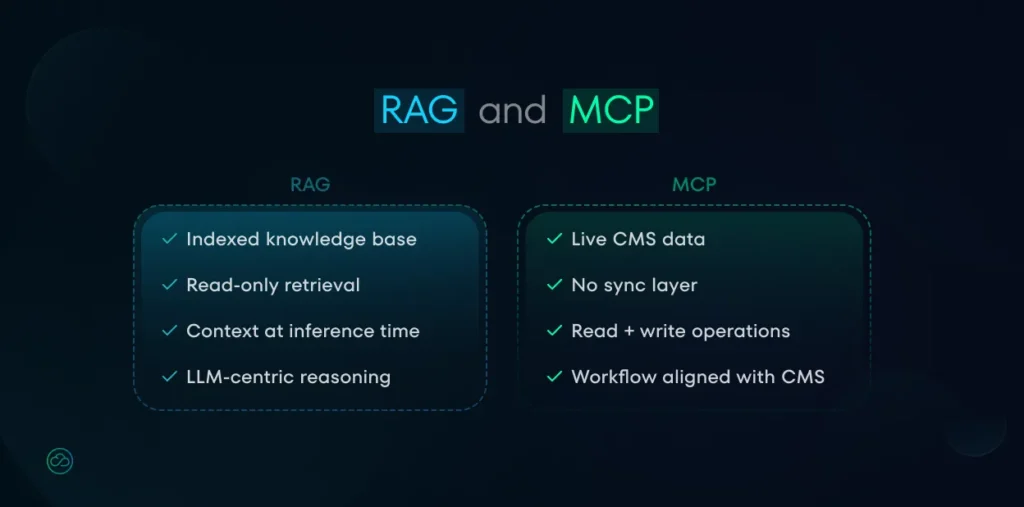
At an early stage, we considered a classic RAG-based approach, which would require building an additional index – most commonly a vector database – based on content stored in WordPress. In the case of a dynamic CMS, where content is continuously added, edited, and reorganized, such an approach requires regular reindexing. This introduces additional operational overhead, ongoing maintenance costs, and the risk of AI working on outdated information. Given the scale and growth rate of the Gesundheit Bewegt platform, this significantly limited the flexibility of the solution.
Equally important were the functional limitations of RAG. This approach supports read-only use cases such as semantic search, summarization, and text generation based on existing knowledge, but it does not allow for executing real operations in the source system. The team, however, wanted to improve their existing editorial workflow, where AI would not only analyze content but also perform concrete actions in WordPress, such as creating new posts, assigning categories, or publishing content.
For these reasons, RAG did not meet the key requirements of the project. We had to look for an alternative.
What instead of RAG?
Instead of adding another knowledge layer alongside WordPress, we chose a solution that operates directly on the source system. This approach eliminates the need for data synchronization and allows the team to work without changing their existing workflows, while still providing AI with access to up-to-date data and platform functionality.
To solve this, we implemented an MCP (Model Context Protocol) server between WordPress and the AI tools. It exposes a controlled set of WordPress operations to AI, instead of limiting access to read-only content.
The delivered solution was built on the abilities-api and mcp-adapter mechanisms. As a result, language models can not only analyze content but also perform specific actions within the CMS – fully aligned with the platform’s existing roles, permissions, and structural constraints.
MCP server implementation details in a complex WordPress setup
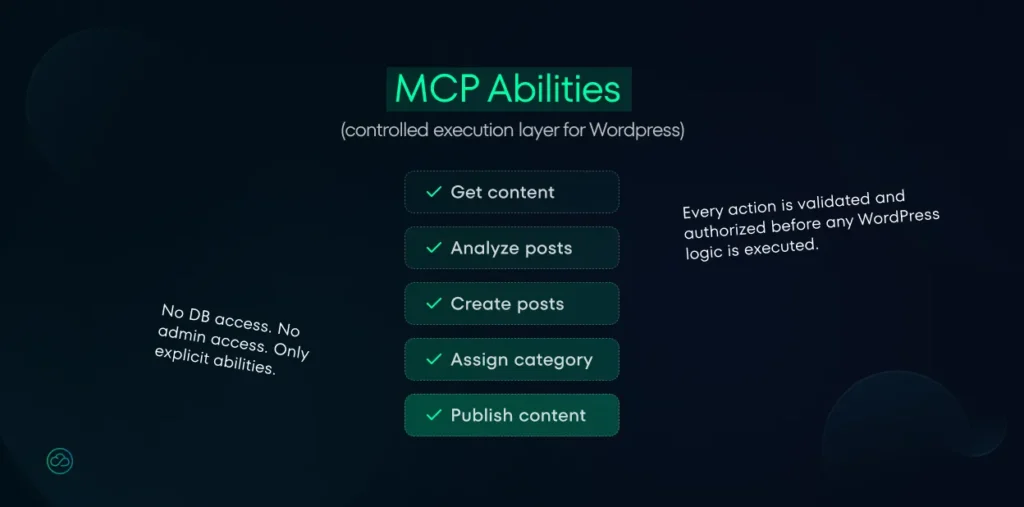
At the core of the solution were abilities – precisely defined WordPress operations exposed to AI as a controlled execution layer. Each ability acts as a strict contract, defining allowed inputs, outputs, and permission checks, which makes it possible to validate and authorize requests before any WordPress logic is executed.
Instead of granting broad access to the CMS or database, we exposed a limited set of capabilities that map directly to real editorial tasks.
These abilities support both read and write operations. AI can retrieve and analyze content using live WordPress data, but it can also perform concrete actions such as creating posts, assigning categories and taxonomies, and publishing content. This approach allows AI to operate within real editorial workflows and works reliably even in environments with custom post types, non-standard data structures, and content builders.
For integration with AI tools, we used the mcp-wordpress-remote library, which enables the MCP server to connect with environments such as Claude Desktop or VS Code Copilot. This keeps the solution model-agnostic and avoids locking the platform into a single AI provider.
Security and access control were implemented using WordPress application passwords assigned to a dedicated technical user. Each ability enforces its own authorization logic based on roles and permissions, allowing precise control not only over which content types AI can access, but also over which actions it is allowed to perform within the WordPress environment.
Outcome
Deploying the MCP server made AI a practical part of daily editorial work in WordPress.
- Instead of functioning as an external drafting or research tool, AI can now perform specific CMS operations – such as creating posts, assigning categories, and publishing content – within clearly defined permissions.
- The solution operates directly on live WordPress data and functions, without creating a separate knowledge base or requiring content synchronization. This meant that the team continued to use the same workflow and AI tools, but they no longer had to copy content manually or deal with the extra work involved in running two systems at once.
- By exposing only explicitly defined operations through MCP abilities and enforcing role- and capability-based authorization, the integration remains secure and predictable. The architecture adapts to custom content types and complex WordPress structures, scales with the platform’s growth, and stays independent of a specific AI model or vendor.

Lessons learned
- Designing and implementing MCP servers for WordPress-based systems
We gained hands-on experience adapting the MCP protocol to complex CMS environments, including working with custom content types and non-standard data structures. - Securely exposing the CMS to AI tools
We developed an approach for controlling AI access to WordPress content based on roles, permissions, and dedicated authorization mechanisms – rather than granting broad access to the knowledge base. - Integrating existing AI workflows with production systems
We gained experience connecting already configured AI tools (e.g., Claude Desktop, Copilot) to existing platforms without forcing changes in models or team processes.
If you’re facing a similar challenge – running a content-heavy WordPress platform and looking to integrate AI securely – share your contact details. We’d be happy to talk through possible approaches and see whether we can help.
People who read this article also read: